A Property Industry Case Study on Outbound Calling Efficiency and Sales Performance
Outbound calling works well for property companies to target prospective customers and create sales leads. However, making hundreds of calls does not necessarily indicate that the campaign is successful.
The crucial thing here is the number of calls that have converted into potential sales leads.
In this case study, we will analyze an outbound calling campaign of a property company and learn more from the call data.
In the case of property, outbound calling can help sales teams proactively reach potential clients. Nevertheless, as with most sales groups, mere numbers were not enough in order to know how well the campaign was performing.
The call could have led to a sales conversation, no answer, an invalid phone number, or an uninterested client.
Without a more in-depth analysis, it is impossible to see where the opportunities arise, as well as where they get lost.
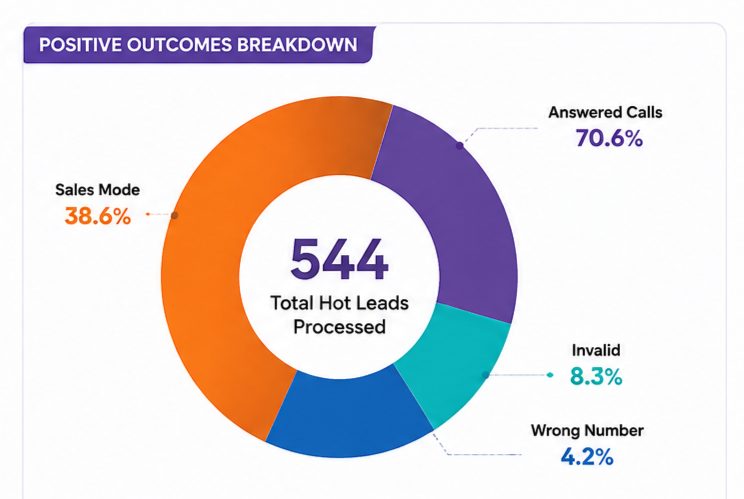
In this campaign, 384 calls were picked up, which amounts to 70.6% of all calls. Out of those answered calls, 210 calls resulted in sales, while others were invalid or incorrect numbers.
With this data, the company gains not only the number of calls, but also it gets an understanding of how the customers reacted to calls during the entire campaign.
Of course, knowing whether or not the call led to sales is just a half of the task. However, for the sales team that deals with the sale of properties, the second half of the task is equally important.
It may turn out that the customer is not yet ready to make his decision during the first call. He may need more time, more information or he may just be interested in a certain property.
This is where Wingo's Call CRM system becomes valuable.
Using this system, the callers do not have to use notebooks or different spreadsheets. They can record the outcome of each call right in the system and then write down their remarks regarding the prospect.
Call recording is another feature provided by Wingo's Predictive Dialer System, which can prove valuable when authorized teams have to go through past calls when required.
It can prove helpful especially in the case of property businesses, wherein the calls may include particular needs, budget, location, and appointments.
Thus, managers don't need to solely depend upon their memory or manual reports.
Ultimately, the reason for recording 544 calls is not merely to show that calls have been made. What matters is to know what happened with these prospects and what needs to be done next.
Predictive Dialer helps make sure that more calls will be made to prospects, and at the same time, it will record results of calls, notes, and dialogues.
The result is that the process of making calls by property businesses becomes more organized and controllable.
Technology alone, however, is not the whole answer. Outbound sales calls need to be monitored and measured, and consistently executed in order for them to be effective.
Through Wingo's outbound call center services, it enables companies to merge calling technology with managed calling service and performance measurement.
This means that managers have more information about what is happening and can concentrate on the overall picture.
The key lesson from this property campaign is simple: Outbound sales performance cannot be measured by call volume alone.
Call volume does play a role. The bigger question is knowing what transpires after each and every call. With the use of predictive dialers and call process performance measurement, property organizations can streamline their outbound sales process and uncover opportunities within their prospects list.
For property businesses, dialing more numbers is just the beginning.
The true advantage lies in understanding the results that are being generated by those calls.
Through this case study, it is shown how call tracking and predictive dialing will provide businesses greater insight into the results of their outbound sales efforts.
See what Wingo Starr can support your sales process with outbound call center services.